

Fractional Business Development vs Hiring a BD Manager: What a CRO or CDMO Should Actually Compare

Updated: Sep 28
Key Takeaways
The real comparison is not salary, it is fully loaded cost. A US biotech business development manager averages about $136,000 in base pay, and standard loading of 1.25x to 1.4x puts the true annual cost closer to $170,000 to $190,000 before any commission.
Ramp time is the hidden line item. Average B2B ramp has stretched to roughly 5.7 months in 2026, and complex enterprise selling runs 9 to 12 months. Add a 6 to 18 month CRO or CDMO sales cycle and your first signed contract can sit 18 to 24 months after the offer letter.
The downside case is expensive and common. Sales turnover averages about 35% per year, average rep tenure is roughly 18 months, and peak performance arrives at 24 to 36 months. Most teams never see the output they paid for.
Fractional is now a mainstream operating choice, not a stopgap. Roughly 35% of US companies used a fractional leader in 2025, with projections near 48% by the end of 2026, and typical savings of 40% to 70% versus a full-time executive at a comparable seniority.
Pick on stage, not on price. Below roughly 3 to 5 qualified opportunities per month, a fractional consultant usually wins on cost and speed. Above that, and with a repeatable playbook already written, an in-house hire starts to compound.
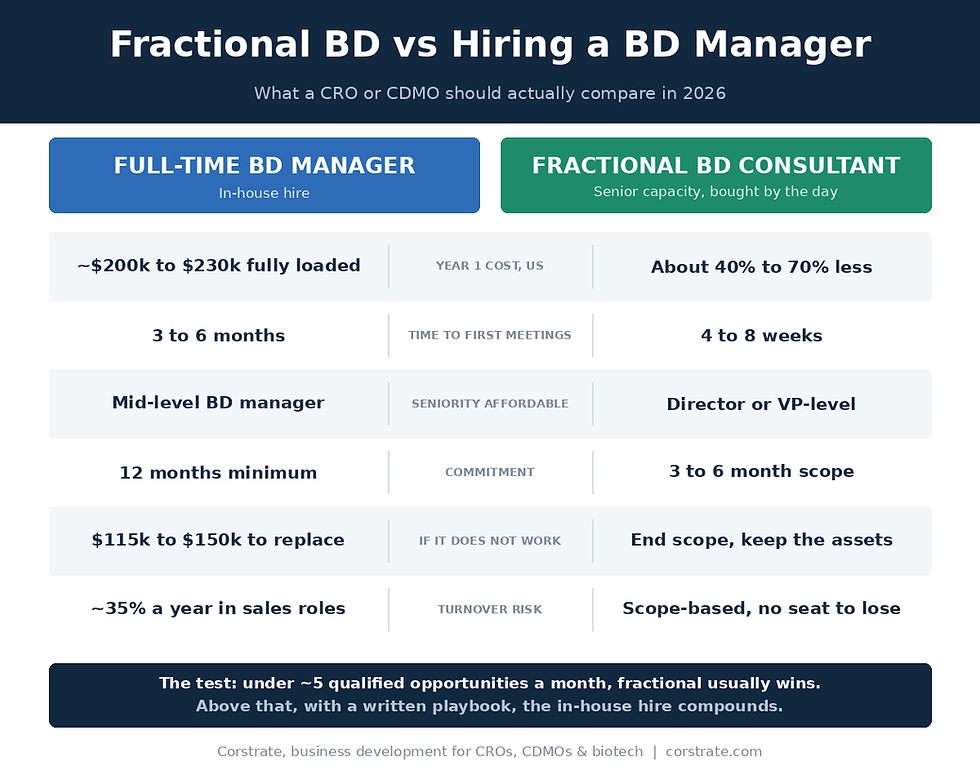
Every CRO and CDMO founder reaches the same fork. Referrals and the founder's own network carried the first few million in revenue, then flattened. The obvious next move is to hire a business development manager. The less obvious move, and increasingly the one that works better for a company under about 50 people, is to buy senior business development capacity by the day instead of by the year.
This piece is the comparison nobody puts in the job description. Not a pitch for either model, a cost and risk model you can run against your own numbers.
Why this decision matters more in 2026
The market is not the problem. Estimates of the 2026 pharmaceutical CDMO market cluster between roughly $215 billion and $275 billion depending on the research firm, growing at something like 6% to 9% a year (Mordor Intelligence, Towards Healthcare). Demand exists. What is scarce is commercial bandwidth inside small and mid-sized service providers, which is exactly the gap we cover in our analysis of business development challenges for CDMOs and for small and mid-sized CROs.
So the fractional business development vs hiring BD manager question is really a capital allocation question: what is the fastest, lowest-risk way to convert a growing market into signed contracts, given that you probably have one shot at getting this year's commercial spend right.
The full cost of an in-house BD manager
Start with base pay. In the United States, a business development manager in biotech averages about $136,490 as of August 2026, with a typical range of roughly $109,000 to $162,000 (Salary.com). In Europe, a global business development director in Germany averages about 118,481 euros base plus roughly 22,263 euros bonus (ERI SalaryExpert), and Switzerland runs 15% to 25% above Western European averages.
Now load it. The widely used MIT rule of thumb puts true employee cost at 1.25 to 1.4 times base salary once payroll taxes, benefits, insurance, equipment and overhead are counted, and US federal data from late 2025 shows benefits at about 29.9% of total compensation for private-industry workers (BLS compensation data). On a $136,000 base that is roughly $170,000 to $190,000 a year, before commission, before travel, before the conference budget you will need to send them to CPHI or DCAT.
Then add acquisition cost. SHRM's 2025 benchmarking puts average cost per hire at $5,475 for non-executive roles and $35,879 for executive hires (SHRM 2025 benchmarks). If you use a search firm instead, contingency fees commonly run 15% to 25% of first-year base and retained executive search runs 25% to 35%.
A realistic first-year cash figure for a solid mid-level BD hire in the US, all in, lands somewhere around $200,000 to $230,000. In the EU the number is lower but the notice periods and termination protections are longer, which shifts the risk rather than removing it.
The two costs nobody budgets: ramp and failure
Ramp
Average B2B ramp time has risen from about 4.3 months in 2020 to roughly 5.7 months in 2026, a 32% increase in four years (sales ramp benchmarks 2026), and enterprise B2B selling commonly needs 9 to 12 months. Layer that onto the life sciences reality that complex CRO, CDMO and platform deals typically take 6 to 18 months from first touch to signature. Do the arithmetic honestly and the first contract a new hire personally originates may not close until month 18 to 24. That is two budget cycles of cost against zero attributable revenue.
Failure
Sales turnover averages roughly 35% annually, versus about 13% across all industries, and more than 45% of B2B sales organisations report turnover above 30% (sales rep turnover statistics). Average tenure is about 18 months while peak performance arrives at 24 to 36 months. Fully loaded replacement cost per departure is commonly put at $115,000 to $150,000. In a small CRO or CDMO, a failed BD hire does not just cost money, it costs a year of market timing and leaves your pipeline colder than when you started.
Fractional business development vs hiring BD manager, side by side
Dimension | Full-time BD manager | Fractional BD consultant |
Year-one cash cost (US, indicative) | About $200,000 to $230,000 fully loaded, including hiring cost and commission | Typically 40% to 70% less at comparable seniority, scoped as a monthly retainer |
Time to first qualified meetings | 3 to 6 months after start date, once ramped | 4 to 8 weeks, using an existing network and playbook |
Seniority you can afford | Mid-level, because senior BD directors price out of a small company budget | Director or VP-level experience, bought in fractions of a week |
Commitment | 12 months minimum in practice, longer under EU notice rules | 3 to 6 month scopes, adjustable as pipeline changes |
Downside if it fails | $115,000 to $150,000 replacement cost plus 12 to 18 months lost | End the engagement, keep the CRM, sequences and target list |
Coverage | One person, one territory, one network | Strategy, targeting, outreach and conference prep from one senior operator |
Institutional knowledge | Stays in-house, compounds over years | Must be deliberately documented and handed over |
Best fit | Repeatable playbook exists, 5+ qualified opportunities a month to work | Playbook does not exist yet, or volume does not justify a full seat |
Numbers are indicative and should be modelled against your own comp bands and deal sizes. Cost savings range from Vendux 2026 fractional executive data.
Where the in-house hire genuinely wins
Being fair about this matters, because the wrong recommendation costs a client a year.
Hire in-house when your pipeline already produces more than roughly 5 qualified opportunities a month and someone needs to work them daily. Hire in-house when the sales motion is documented, meaning you know your ICP, your qualification criteria, your proposal structure and your win themes, so a new person has something to ramp into rather than invent. Hire in-house when the role requires deep technical fluency in a single modality and the learning curve only pays back over years. And hire in-house when you can genuinely fund 18 to 24 months of runway for that seat without flinching if quarter three is quiet.
If two or more of those are not true today, you are not hiring a BD manager, you are funding an experiment with a 35% annual failure rate.
Where fractional wins
Fractional business development has moved from stopgap to standard practice. The global fractional executive market reached about $5.7 billion in 2025 growing at roughly 14% a year, roughly 35% of US companies used a fractional leader in 2025 with projections near 48% by the end of 2026, and mid-market companies show the highest adoption at about 42% (Sci-Tech Today, Ancore Partners).
The structural advantage is seniority per euro. A small CDMO cannot afford a VP of Business Development at 180,000 euros plus. It can afford two days a week of one. That buys judgement on which accounts to chase, not just activity, and judgement is what decides whether a 6 to 18 month cycle ends in a signature. The second advantage is that the asset stays with you: a defined ICP, a scored target list, working sequences, a clean CRM and a conference plan are all portable, and they are exactly what makes the eventual in-house hire succeed instead of flounder. We go deeper on the operating model in our pillar piece on fractional business development for life sciences companies. The scope and deliverables of our own model are set out on our fractional business development service page.
A simple decision test
Run these four questions before you post the job.
Volume. How many qualified opportunities entered your pipeline in the last 90 days? Under 9, a full seat is not yet justified. Our guide to pipeline optimization covers how to measure this properly.
Playbook. Could you hand a new hire a written ICP, qualification framework and proposal template on day one? If not, you would be paying a mid-level salary for strategy work.
Runway. Can you absorb 18 months of fully loaded cost before attributable revenue? If the answer is "if things go well", that is a no.
Seniority gap. Is your problem too few conversations, or the wrong conversations? Volume problems respond to headcount. Targeting problems respond to experience.
Many CROs and CDMOs land on a sequence rather than a choice: six to nine months fractional to build the engine and prove the market, then hire a mid-level BD manager to run the machine that now exists, with the fractional consultant staying on light-touch for strategy. That is usually cheaper and considerably safer than either extreme, and it is how we structure most Corstrate engagements. If you want to see what the outbound layer looks like in practice, start with LinkedIn prospecting for pharma and biotech and pharmaceutical lead generation.
What to ask before you sign either
For a candidate: which accounts have you personally opened in this modality, what was the cycle length, and what did the first 90 days look like? Ask for the deal, not the logo.
For a fractional consultant: what exactly is delivered by day 30, day 60 and day 90, who owns the CRM and the contact data, how many other clients are in adjacent segments, and what does handover look like if we hire in-house next year? A good consultant answers all four without hesitating, and writes them into the scope.
Frequently asked questions
What does fractional business development cost for a CRO or CDMO?
Engagements are usually scoped as a monthly retainer tied to days per month rather than an hourly rate. Benchmarks across the fractional executive market show savings of roughly 40% to 70% versus a full-time executive at comparable seniority, so a small CRO typically spends a fraction of a $200,000 fully loaded BD seat while accessing director or VP-level experience.
How long before a new BD manager generates revenue in life sciences?
Plan for 18 to 24 months to attributable closed revenue. Average B2B ramp is about 5.7 months in 2026 and enterprise selling runs 9 to 12 months, and complex CRO or CDMO deals then take 6 to 18 months from first touch to signature. Earlier revenue usually comes from the network the hire brought with them, not from pipeline they built.
Is fractional BD only for companies that cannot afford a hire?
No. Roughly 35% of US companies used a fractional leader in 2025 and mid-market companies show the highest adoption. The common reason is not affordability, it is that the company needs senior judgement on targeting and positioning, which is a part-time need, rather than daily pipeline execution, which is a full-time need.
Can we use both a fractional consultant and an in-house BD manager?
Yes, and it is often the strongest structure. Use a fractional consultant to define the ICP, build the target list and prove which segments convert, then hire a mid-level BD manager into a working system. The hire ramps faster because the playbook already exists, which directly attacks the 35% sales turnover problem.
What should we keep if a fractional engagement ends?
Everything operational: the CRM and its data, the scored account list, the messaging and sequences, the conference plan and the qualification criteria. Write asset ownership and handover into the scope of work on day one, not at the end.


Comments